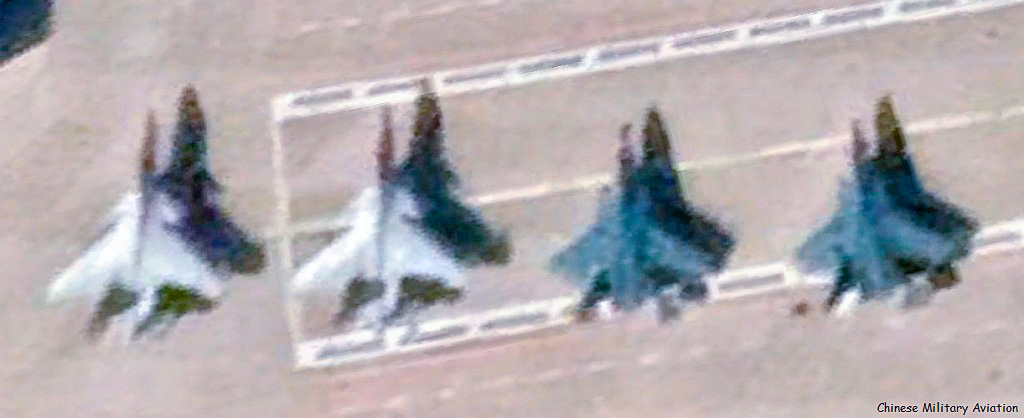
It was rumored in late 2018 that the 611 Institute has started to develop key technologies for the next generation fighter which is expected to enter the service by 2035. A recent satellite image (October 2021) suggested a full-scale mockup or a technology demonstrator featuring tailless diamond wings has been built at CAC. A patent application released in May 2023 suggested that the 611 Institute was studying a stealth STOVL fighter concept featuring a forward lift engine and a rear main engine with thrust vectoring nozzles. A future STOVL stealth fighter is speculated to be stationed onboard the Type 076 LHD.
 J-20 Mighty Dragon/Fagin
 The J-20 (K/JJ20?) #2001 technology demonstrator made its maiden flight on January 11, 2011 over the city of Chengdu, wearing a distinctive dark gray color scheme and powered by two AL-31F series turbofan engines. The prototype features a pair of all-moving tail fins and Russian 1.44 style twin ventral stabilizing fins and tail booms, which shield the engine nozzles and its heat exhausts but might increase RCS. Also there are four large underwing actuator fairings but their size was reduced on later prototypes. It also features an F-22 style nosecone, F-35 style engine inlets with non-adjustable DSI bumps installed at the upper inner corners, as well as a one-piece frameless canopy. Small LERX are installed between the canards and main wings in order to generate vortex together with the canards at high AoA. Two small dark diamond shaped windows can be seen on both sides of the nose, which could house EO sensors. Two more diamond shaped windows are seen underneath the rear fuselage, plus two more located forward and aft the cockpit, suggesting a distributed situational awareness system similar to the EODAS onboard American F-35 could have been installed to provide a full 360° coverage. Besides a large belly weapon bay for medium/long-range AAMs (up to 4 PL-15), two smaller lateral weapon bays have been identified behind the air inlets for short-range AAMs (one PL-10 in each, later PL-16). First disclosed by US Office of Naval Intelligence (ONI) in 1997 as XXJ, J-20 (Project 718) is a 4th generation heavy air superiority fighter which has entered the service with PLAAF in 2016, a time frame much faster than the one (>2020) anticipated by the western military analysts. Since early 90s both CAC/611 Institute and SAC/601 Institute had been working their own designs to bid for a twin-engine heavy fighter with stealth capability and maneuverability comparable to American F-22. It was speculated that 601 Institute had worked on a "tri-plane" design based on canard/conventional layout/V-shape tail fin while 611 Institute working on a design based on canard/tailless delta wing/V-shape tail fin/lateral DSI/bump inlet layout. All designs would feature a belly internal weapon bay to reduce RCS, which has been speculated to be <0.05m2 (head-on). J-20 also incorporates an advanced optic HSDB system fully integrating the fire-control and the engine systems. The aircraft has a smooth surface without any protruding tubes or inlets, suggesting an FADS has been installed in order to reduce RCS. Its fire-control radar is believed to be a wide-band AESA (Type 149x?) based on the less powerful model onboard J-10C, both are developed by the 14th Institute. The radar is thought to be comparable to American APG-77. Both the radar and the CNI system were tested onboard a modified Tu-204C avionics testbed, similar to American Boeing 757 testbed for F-22. The diamond shaped advanced datalink (MADL) antennas are believed to have been mounted on the fuselage and wing surfaces which provides secure networking with other J-20s and KJ-200/500/2000 AWACS. The aircraft also features a "pure" glass cockpit and HMD. J-20 has a retractable IFR probe hidden beneath a cover on the starboard side of the cockpit similar to the one onboard F-35, which indicates that the aircraft can be supported by the YY-20A tanker fleet. It also has visible/IR duel mode EL formation light strips installed below the cockpit and on the tail fins. Many of these subsystems have been tested onboard J-10B/C to speed up the development. The exact types of engine powering prototypes are unclear, even though a Russian or Chinese turbofan engine including AL-31F-M1/M2 (13.5t/14.5t class) and enhanced WS-10 (WS-10C? 14t class) was speculated. In the end the Russian engine is believed to be the likely candidate. It has been speculated that either all prototypes are powered by AL-31F-M1, or 200x technology demonstrators are powered by AL-31F-M1, then 201x prototypes and LRIP J-20s are powered by AL-31F-M2 (A Configuration?). The engine was once fitted with a silver color (ceramic coating?) "stealth" nozzle with sawtooth edges to reduce RCS and IR emission but it was not adopted in the end. As the result J-20 in current configuration is under-powered and lacks the super-cruise capability. It was first reported in November 2006 that a 16-17t class T/W=9 turbofan (WS-15/"Large Thrust"/Zhumulangma) with a TVC nozzle is being developed and will eventually power J-20s of later production batches (B Configuration?). Therefore J-20 is expected to finally gain the super-cruise capability once the WS-15 turbofan becomes available. Russian assistance was also speculated in terms of software support for calculating the RCS and aerodynamics of various designs. The overall performance of J-20 is thought to be superior to that of Russian T-50 and on par with that of American F-22. Currently in service, J-20 has posed a significant impact/challenge to the air power balance in
eastern Asian and western Pacific region. It has prompted the
neighboring countries including Japan and South Korea to pursue their own 4th/5th-generation stealth fighters such as F-35. Some specifications: length 21.2m, height 4.69m, wingspan 13.01m, max speed >Mach 2. In August 2008 it was reported that 611 Institute was selected to be the main contractor for the development of J-20 and 601 Institute as the sub-contractor. Subsequently a full-scale metal mockup was built at CAC. One rumor in May 2010 claimed that 611 Institute started to construct the first prototype, which was expected to fly by the end of 2010. Two technology demonstrators were constructed and the first low-speed taxi trial by #2001 took place on November 4, 2010. The #2002 made its maiden flight on May 16, 2012. Both #2001 and #2002 were sent to CFTE in Yanliang in 2012, where #2002 was renumbered as 2004 and #2001 tested a light gray RAM paint. In March 2013 the #2002 technology demonstrator was seen conducting weapon integration tests with a dummy PL-10 IIR guided short-range AAM (to be followed by PL-16) on its retractable side missile launch rail. Unlike that of F-22, the weapon bay door is closed while the missile rack is fully extended externally to maintain low RCS and reduce drag during dogfight. In July 2013 it conducted similar tests carrying dummy PL-15 AAMs inside the belly weapon bay. The building the third J-20 was delayed until late 2013 due to the fact that the new #2011 prototype features certain "major improvements" and is no longer considered as a "technology demonstrator". The first low-speed taxi test of #2011 prototype took place on January 16, 2014, high-speed taxi test on February 18, 2014. The aircraft was seen to have a nosed mounted IRST and an F-35 style frame-strengthened one-piece canopy plus a wide-angle holographic HUD with a slimmer frame. Its cockpit might have also been upgraded with a single 24x9" touchscreen panoramic cockpit display (PCD) similar to that of F-35 plus a smaller LCD between the legs. As the result a side-stick and the throttle are expected to be installed to control the aircraft. The combination of AESA radar, EODAS, IRST, advanced cockpit design and HMD further improves pilot's situation awareness by providing the highest degree of "information fusion". The emergence of IRST suggests that J-20 might possess a limited AG capability using laser or TV guided PGMs. In addition it has numerous aerodynamic refinements including reshaped tail fins, extended tail booms, nose landing gear door, LERX and engine intakes with two hexagonal inlet/outlet of the fuel-air heat exchanger as well as smaller underwing actuators to further reduce RCS. Two side-looking radar antennas may have been installed underneath the elongated hexagonal dielectric fairings (in X & Z axes) on each side of the nose. Two large tail booms appear to house additional ECM or rear-view radar antennas to protect the rear hemisphere of the aircraft. A new ECM antenna can be seen aft the air intake as well. The 201x prototype also started to wear a new light blue/medium gray RAM coating. The #2011 prototype first took off into the sky on March 1, 2014. Different types of "stealth" nozzle were tested on one of the engines onboard #2011 in April 2014. The first flight of #2012 took place on July 26, 2014. The #2013 prototype took off for the first time on November 29, 2014, and the #2015 prototype on December 19, 2014. Both 2013 and 2015 have the pitot tube removed from the nose and both feature a further refined nose radome and tail booms, suggesting the AESA radar has been installed. They were speculated to represent a nearly "frozen" technical configuration before the initial production started. It was rumored in April 2015 that both 2013 and 2015 prototypes were to be transferred to CFTE for further testing. The #2016 prototype made its first flight on September 18, 2015. The aircraft appears to feature slightly reshaped DSI bumps, engine nozzles as well as a new ejection seat. The aircraft was transferred to CFTE for further testing on December 2, 2015. The last prototype (#2017) had its maiden flight on November 24, 2015 before the initial production started in late 2015. The aircraft appears to feature a slightly reshaped canopy. Two pairs of chaff and flare launchers were installed in the tail booms between the tail fin and the engine nozzle. There were speculations that a compartment was reserved for an internal gun (Gatling style 23mm cannon?) underneath a top panel on the starboard side of the fuselage next to the canard wing. This design was rumored to have been tested onboard one of the prototypes. However in the end it was decided that the production model will be produced without a gun. A new J-20 in yellow primer first appeared in December 2015 which was likely to be the first LRIP model (2101, 00 batch). First flight took place on January 18, 2016. More 00 batch J-20s (CB00xx) are being built in 2016, at least 4 (2101-2104?) by mid-2016, wearing a medium gray color scheme and low-visibility PLAAF insignias. The aircraft appears to have 4 hardpoints underneath the wings for external payloads such as PL-10/PL-15 AAMs and drop tanks. Furthermore up to 8 missiles can be carried externally with dual launch rails. They can be carried during routine air patrols in peacetime. The pylons can be jettisoned in case of an emergency situation and the aircraft will quickly turn into the stealthy combat mode. The first batch of six was expected to enter the service with PLAAF Dingxin Flight Test & Training Base by the end of 2016 (S/N 78x7x). Recent images (October 2016) indicated that two LRIP aircraft were wearing a new splinter camouflage similar to that of Russian T-50. In addition test flights were flown by #2012 prototype at CFTE carrying four 2,400L (?) drop tanks for long-range escort/interception missions. J-20 was officially unveiled to the public at the 2016 Zhuhai Airshow. The first two J-20s were handed over to PLAAF Dingxin Flight Test & Training Base on December 12, 2016 (S/N 78x7x). An image released in September 2017 indicated that since early 2017 an improved J-20 (Status II?) prototype (#2021) has been fitted with two indigenous WS-10C turbofan engines (14t class) featuring nozzles with sawtooth edges to reduce RCS, suggesting that Chinese have finally developed a more advanced engine to replace its Russian counterpart. First flight of J-20 (II) #2021 took place on September 19, 2017. The aircraft was transferred to CFTE on December 27, 2017. The second prototype (#2022) was believed to haven flown for the first time in January 2018, which might carry a shoulder mounted internal gun. In February 2018 it was reported that J-20 (01 batch/CB01xx) has entered the service with PLAAF Cangzhou Flight Training Base (S/N 78x3x). The first two J-20s was rumored to have entered the service with the PLAAF 9th Brigade at Wuhu Airbase on January 13, 2019, facing Japan and Taiwan (S/N 62x0x). Recent satellite images (August and September 2020) indicated that J-20s were deployed to the Hotan Airbase facing India as well as Quzhou Airbase facing Taiwan. A recent image (January 2021) suggested that the first batch of J-20 (II) has entered the service with PLAAF Cangzhou Flight Training Base (S/N 78x3x, later 03 batch/CB03xx). Another recent image (April 2021) suggested that J-20 (II) has entered the service with PLAAF 1st Brigade at Anshan Airbase (S/N 61x2x, 02 batch/CB02xx) facing South Korea and Japan. J-20 (II) was publicly unveiled at the 2021 Zhuhai Airshow. Another recent image (January 2022) indicated that J-20 (II) has entered the service with PLAAF 5th Brigade at Guilin Airbase facing Southeast Asia (S/N 61x6x). Another recent image (March 2022) indicated that J-20 (II) has entered the service with PLAAF 56th Brigade in Zhengzhou (S/N 66x7x). It was rumored in April 2022 that J-20 (II) is entering the service with PLAAF 111th Brigade (S/N 72x2x?) in Korla facing India. The latest images (March & April 2024) indicated that J-20 (II) has entered the service with PLAAF 97th and 54th Brigades (S/N 70x8x, 66x5x). All J-20s are now believed to have been fitted with a retractable Luneburg lens underneath the mid-fuselage for switching quickly between stealth and non-stealth flight mode. A recent image (June 2021) suggested that a single WS-10C engine modified with a TVC nozzle was fitted on a J-20 (#2012) engine testbed at CAC. The axial-symmetrical TVC nozzle appeared similar to that of the WS-10B3 engine tested earlier onboard the J-10B TVC demonstrator. In addition, compared to WS-10C, its nozzle has a shorter length and a larger diameter. Consequently the twin ventral stabilizing fins might have been removed to reduce weight and RCS. The engine intake is also expected to have been enlarged to increase the air flow. A recent news (January 2022) suggested that a towed decoy similar to American AN/ALE-70 is being developed for J-20, which is speculated to be installed inside its tail cone. Another news (March 2022) suggested that PLAAF J-20 engaged USAF F-35 over the East China Sea. At least 156 J-20s in 8 batches were produced by the end of 2022. A recent image (September 2023) suggested that J-20 was practicing escort missions with the H-6K bomber formation.
The J-20 (K/JJ20?) #2001 technology demonstrator made its maiden flight on January 11, 2011 over the city of Chengdu, wearing a distinctive dark gray color scheme and powered by two AL-31F series turbofan engines. The prototype features a pair of all-moving tail fins and Russian 1.44 style twin ventral stabilizing fins and tail booms, which shield the engine nozzles and its heat exhausts but might increase RCS. Also there are four large underwing actuator fairings but their size was reduced on later prototypes. It also features an F-22 style nosecone, F-35 style engine inlets with non-adjustable DSI bumps installed at the upper inner corners, as well as a one-piece frameless canopy. Small LERX are installed between the canards and main wings in order to generate vortex together with the canards at high AoA. Two small dark diamond shaped windows can be seen on both sides of the nose, which could house EO sensors. Two more diamond shaped windows are seen underneath the rear fuselage, plus two more located forward and aft the cockpit, suggesting a distributed situational awareness system similar to the EODAS onboard American F-35 could have been installed to provide a full 360° coverage. Besides a large belly weapon bay for medium/long-range AAMs (up to 4 PL-15), two smaller lateral weapon bays have been identified behind the air inlets for short-range AAMs (one PL-10 in each, later PL-16). First disclosed by US Office of Naval Intelligence (ONI) in 1997 as XXJ, J-20 (Project 718) is a 4th generation heavy air superiority fighter which has entered the service with PLAAF in 2016, a time frame much faster than the one (>2020) anticipated by the western military analysts. Since early 90s both CAC/611 Institute and SAC/601 Institute had been working their own designs to bid for a twin-engine heavy fighter with stealth capability and maneuverability comparable to American F-22. It was speculated that 601 Institute had worked on a "tri-plane" design based on canard/conventional layout/V-shape tail fin while 611 Institute working on a design based on canard/tailless delta wing/V-shape tail fin/lateral DSI/bump inlet layout. All designs would feature a belly internal weapon bay to reduce RCS, which has been speculated to be <0.05m2 (head-on). J-20 also incorporates an advanced optic HSDB system fully integrating the fire-control and the engine systems. The aircraft has a smooth surface without any protruding tubes or inlets, suggesting an FADS has been installed in order to reduce RCS. Its fire-control radar is believed to be a wide-band AESA (Type 149x?) based on the less powerful model onboard J-10C, both are developed by the 14th Institute. The radar is thought to be comparable to American APG-77. Both the radar and the CNI system were tested onboard a modified Tu-204C avionics testbed, similar to American Boeing 757 testbed for F-22. The diamond shaped advanced datalink (MADL) antennas are believed to have been mounted on the fuselage and wing surfaces which provides secure networking with other J-20s and KJ-200/500/2000 AWACS. The aircraft also features a "pure" glass cockpit and HMD. J-20 has a retractable IFR probe hidden beneath a cover on the starboard side of the cockpit similar to the one onboard F-35, which indicates that the aircraft can be supported by the YY-20A tanker fleet. It also has visible/IR duel mode EL formation light strips installed below the cockpit and on the tail fins. Many of these subsystems have been tested onboard J-10B/C to speed up the development. The exact types of engine powering prototypes are unclear, even though a Russian or Chinese turbofan engine including AL-31F-M1/M2 (13.5t/14.5t class) and enhanced WS-10 (WS-10C? 14t class) was speculated. In the end the Russian engine is believed to be the likely candidate. It has been speculated that either all prototypes are powered by AL-31F-M1, or 200x technology demonstrators are powered by AL-31F-M1, then 201x prototypes and LRIP J-20s are powered by AL-31F-M2 (A Configuration?). The engine was once fitted with a silver color (ceramic coating?) "stealth" nozzle with sawtooth edges to reduce RCS and IR emission but it was not adopted in the end. As the result J-20 in current configuration is under-powered and lacks the super-cruise capability. It was first reported in November 2006 that a 16-17t class T/W=9 turbofan (WS-15/"Large Thrust"/Zhumulangma) with a TVC nozzle is being developed and will eventually power J-20s of later production batches (B Configuration?). Therefore J-20 is expected to finally gain the super-cruise capability once the WS-15 turbofan becomes available. Russian assistance was also speculated in terms of software support for calculating the RCS and aerodynamics of various designs. The overall performance of J-20 is thought to be superior to that of Russian T-50 and on par with that of American F-22. Currently in service, J-20 has posed a significant impact/challenge to the air power balance in
eastern Asian and western Pacific region. It has prompted the
neighboring countries including Japan and South Korea to pursue their own 4th/5th-generation stealth fighters such as F-35. Some specifications: length 21.2m, height 4.69m, wingspan 13.01m, max speed >Mach 2. In August 2008 it was reported that 611 Institute was selected to be the main contractor for the development of J-20 and 601 Institute as the sub-contractor. Subsequently a full-scale metal mockup was built at CAC. One rumor in May 2010 claimed that 611 Institute started to construct the first prototype, which was expected to fly by the end of 2010. Two technology demonstrators were constructed and the first low-speed taxi trial by #2001 took place on November 4, 2010. The #2002 made its maiden flight on May 16, 2012. Both #2001 and #2002 were sent to CFTE in Yanliang in 2012, where #2002 was renumbered as 2004 and #2001 tested a light gray RAM paint. In March 2013 the #2002 technology demonstrator was seen conducting weapon integration tests with a dummy PL-10 IIR guided short-range AAM (to be followed by PL-16) on its retractable side missile launch rail. Unlike that of F-22, the weapon bay door is closed while the missile rack is fully extended externally to maintain low RCS and reduce drag during dogfight. In July 2013 it conducted similar tests carrying dummy PL-15 AAMs inside the belly weapon bay. The building the third J-20 was delayed until late 2013 due to the fact that the new #2011 prototype features certain "major improvements" and is no longer considered as a "technology demonstrator". The first low-speed taxi test of #2011 prototype took place on January 16, 2014, high-speed taxi test on February 18, 2014. The aircraft was seen to have a nosed mounted IRST and an F-35 style frame-strengthened one-piece canopy plus a wide-angle holographic HUD with a slimmer frame. Its cockpit might have also been upgraded with a single 24x9" touchscreen panoramic cockpit display (PCD) similar to that of F-35 plus a smaller LCD between the legs. As the result a side-stick and the throttle are expected to be installed to control the aircraft. The combination of AESA radar, EODAS, IRST, advanced cockpit design and HMD further improves pilot's situation awareness by providing the highest degree of "information fusion". The emergence of IRST suggests that J-20 might possess a limited AG capability using laser or TV guided PGMs. In addition it has numerous aerodynamic refinements including reshaped tail fins, extended tail booms, nose landing gear door, LERX and engine intakes with two hexagonal inlet/outlet of the fuel-air heat exchanger as well as smaller underwing actuators to further reduce RCS. Two side-looking radar antennas may have been installed underneath the elongated hexagonal dielectric fairings (in X & Z axes) on each side of the nose. Two large tail booms appear to house additional ECM or rear-view radar antennas to protect the rear hemisphere of the aircraft. A new ECM antenna can be seen aft the air intake as well. The 201x prototype also started to wear a new light blue/medium gray RAM coating. The #2011 prototype first took off into the sky on March 1, 2014. Different types of "stealth" nozzle were tested on one of the engines onboard #2011 in April 2014. The first flight of #2012 took place on July 26, 2014. The #2013 prototype took off for the first time on November 29, 2014, and the #2015 prototype on December 19, 2014. Both 2013 and 2015 have the pitot tube removed from the nose and both feature a further refined nose radome and tail booms, suggesting the AESA radar has been installed. They were speculated to represent a nearly "frozen" technical configuration before the initial production started. It was rumored in April 2015 that both 2013 and 2015 prototypes were to be transferred to CFTE for further testing. The #2016 prototype made its first flight on September 18, 2015. The aircraft appears to feature slightly reshaped DSI bumps, engine nozzles as well as a new ejection seat. The aircraft was transferred to CFTE for further testing on December 2, 2015. The last prototype (#2017) had its maiden flight on November 24, 2015 before the initial production started in late 2015. The aircraft appears to feature a slightly reshaped canopy. Two pairs of chaff and flare launchers were installed in the tail booms between the tail fin and the engine nozzle. There were speculations that a compartment was reserved for an internal gun (Gatling style 23mm cannon?) underneath a top panel on the starboard side of the fuselage next to the canard wing. This design was rumored to have been tested onboard one of the prototypes. However in the end it was decided that the production model will be produced without a gun. A new J-20 in yellow primer first appeared in December 2015 which was likely to be the first LRIP model (2101, 00 batch). First flight took place on January 18, 2016. More 00 batch J-20s (CB00xx) are being built in 2016, at least 4 (2101-2104?) by mid-2016, wearing a medium gray color scheme and low-visibility PLAAF insignias. The aircraft appears to have 4 hardpoints underneath the wings for external payloads such as PL-10/PL-15 AAMs and drop tanks. Furthermore up to 8 missiles can be carried externally with dual launch rails. They can be carried during routine air patrols in peacetime. The pylons can be jettisoned in case of an emergency situation and the aircraft will quickly turn into the stealthy combat mode. The first batch of six was expected to enter the service with PLAAF Dingxin Flight Test & Training Base by the end of 2016 (S/N 78x7x). Recent images (October 2016) indicated that two LRIP aircraft were wearing a new splinter camouflage similar to that of Russian T-50. In addition test flights were flown by #2012 prototype at CFTE carrying four 2,400L (?) drop tanks for long-range escort/interception missions. J-20 was officially unveiled to the public at the 2016 Zhuhai Airshow. The first two J-20s were handed over to PLAAF Dingxin Flight Test & Training Base on December 12, 2016 (S/N 78x7x). An image released in September 2017 indicated that since early 2017 an improved J-20 (Status II?) prototype (#2021) has been fitted with two indigenous WS-10C turbofan engines (14t class) featuring nozzles with sawtooth edges to reduce RCS, suggesting that Chinese have finally developed a more advanced engine to replace its Russian counterpart. First flight of J-20 (II) #2021 took place on September 19, 2017. The aircraft was transferred to CFTE on December 27, 2017. The second prototype (#2022) was believed to haven flown for the first time in January 2018, which might carry a shoulder mounted internal gun. In February 2018 it was reported that J-20 (01 batch/CB01xx) has entered the service with PLAAF Cangzhou Flight Training Base (S/N 78x3x). The first two J-20s was rumored to have entered the service with the PLAAF 9th Brigade at Wuhu Airbase on January 13, 2019, facing Japan and Taiwan (S/N 62x0x). Recent satellite images (August and September 2020) indicated that J-20s were deployed to the Hotan Airbase facing India as well as Quzhou Airbase facing Taiwan. A recent image (January 2021) suggested that the first batch of J-20 (II) has entered the service with PLAAF Cangzhou Flight Training Base (S/N 78x3x, later 03 batch/CB03xx). Another recent image (April 2021) suggested that J-20 (II) has entered the service with PLAAF 1st Brigade at Anshan Airbase (S/N 61x2x, 02 batch/CB02xx) facing South Korea and Japan. J-20 (II) was publicly unveiled at the 2021 Zhuhai Airshow. Another recent image (January 2022) indicated that J-20 (II) has entered the service with PLAAF 5th Brigade at Guilin Airbase facing Southeast Asia (S/N 61x6x). Another recent image (March 2022) indicated that J-20 (II) has entered the service with PLAAF 56th Brigade in Zhengzhou (S/N 66x7x). It was rumored in April 2022 that J-20 (II) is entering the service with PLAAF 111th Brigade (S/N 72x2x?) in Korla facing India. The latest images (March & April 2024) indicated that J-20 (II) has entered the service with PLAAF 97th and 54th Brigades (S/N 70x8x, 66x5x). All J-20s are now believed to have been fitted with a retractable Luneburg lens underneath the mid-fuselage for switching quickly between stealth and non-stealth flight mode. A recent image (June 2021) suggested that a single WS-10C engine modified with a TVC nozzle was fitted on a J-20 (#2012) engine testbed at CAC. The axial-symmetrical TVC nozzle appeared similar to that of the WS-10B3 engine tested earlier onboard the J-10B TVC demonstrator. In addition, compared to WS-10C, its nozzle has a shorter length and a larger diameter. Consequently the twin ventral stabilizing fins might have been removed to reduce weight and RCS. The engine intake is also expected to have been enlarged to increase the air flow. A recent news (January 2022) suggested that a towed decoy similar to American AN/ALE-70 is being developed for J-20, which is speculated to be installed inside its tail cone. Another news (March 2022) suggested that PLAAF J-20 engaged USAF F-35 over the East China Sea. At least 156 J-20s in 8 batches were produced by the end of 2022. A recent image (September 2023) suggested that J-20 was practicing escort missions with the H-6K bomber formation.
- Last Updated 4/8/24





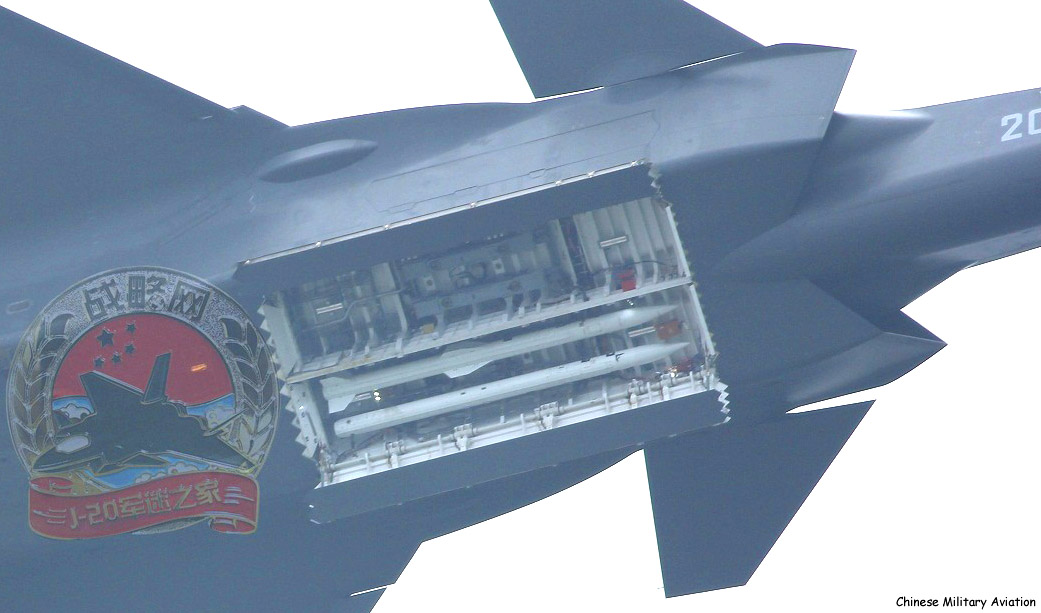


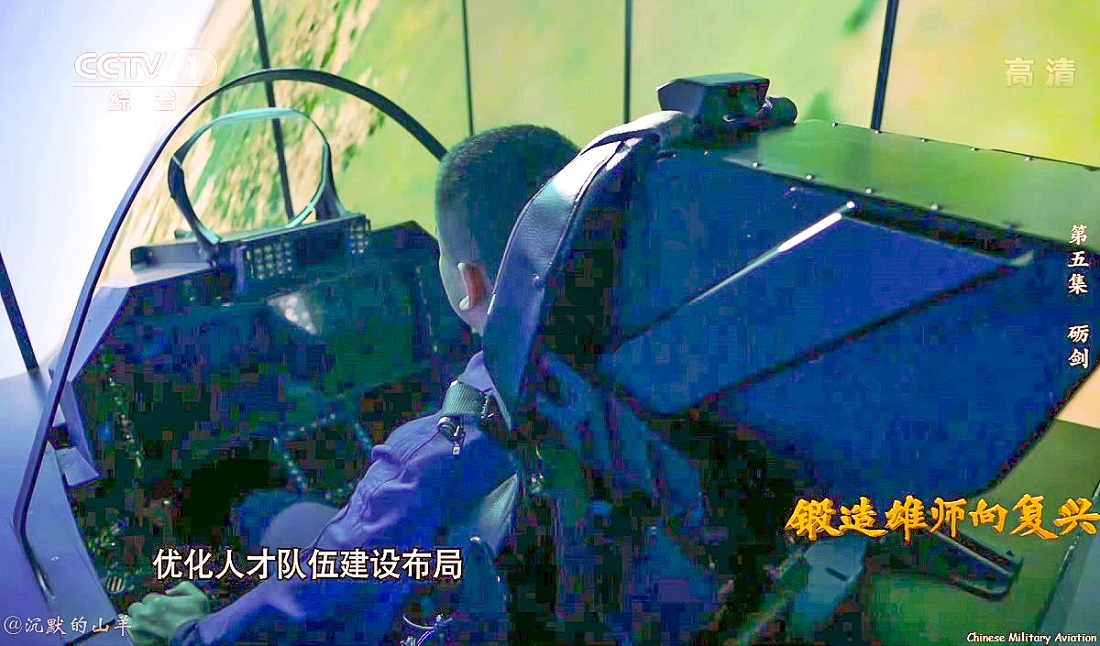


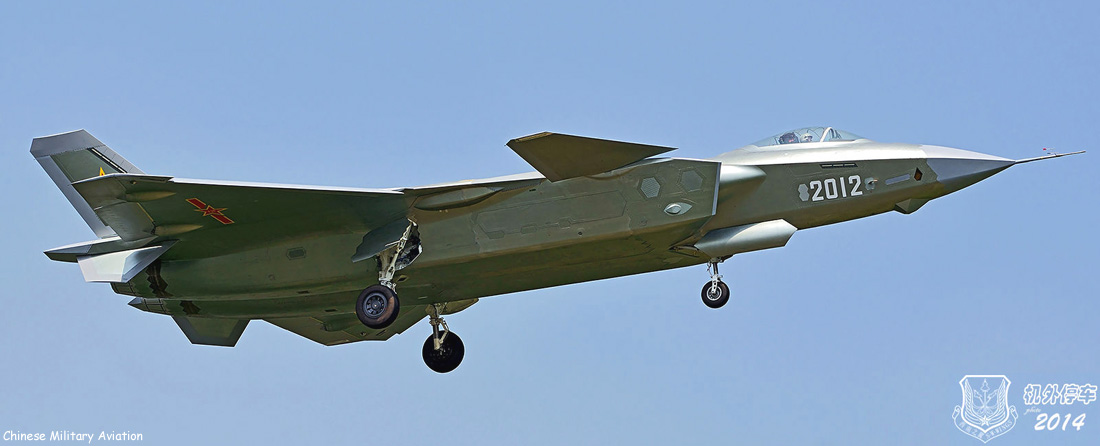


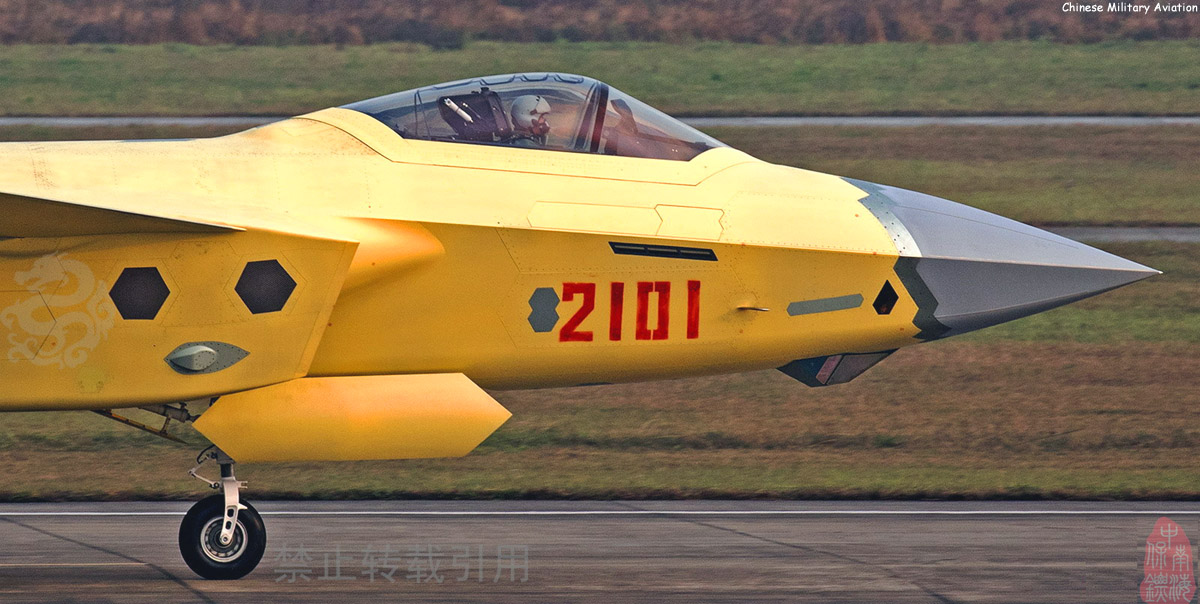


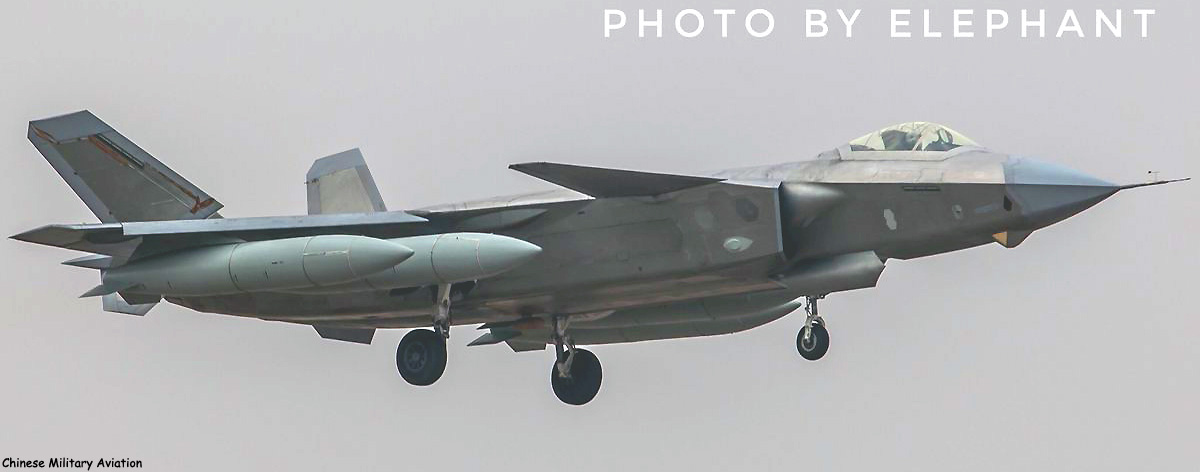


 In December 2022 a new prototype (#2051) started taxi tests at CAC. It was speculated to be the first "full standard" J-20A (Status III?) featuring a slightly raised cockpit with a deeper spine housing additional avionics/fuel as well as a slightly reshaped nose cone to reduce drag. Consequently the aerodynamic drag has been reduced and the AESA radar may have been upgraded to a new GaN type. J-20A appears to have modified engine intakes with a slightly smaller bump at the leading edge, suggesting it might be powered by the WS-15 engine which requires a bigger air flow. The hexagonal heat exchanger inlets/outlets in the engine intake wall were also removed. A recent video (June 2023) suggested that the J-20A #2052 prototype powered by two WS-15 turbofans just conducted its maiden flight. The engine appears to feature only a nozzle with sawtooth edges similar to that of WS-10C but no TVC nozzles. Additional prototypes have been built, including #2055 (first seen March 2024) and #2056.


It was first rumored in January 2018 that a tandem-seat trainer version (J-20B?) was under development at 611/CAC. First flight was expected in 2021. The J-20B prototype conducted the high speed taxi test in October 2021. This variant might feature a fully functional ETOS underneath the nose, enlarged tail fins and could be powered by WS-10C turbofan engines. Consequently the EODAS could have been removed from the aircraft. It was speculated that J-20B could be a multirole stealth fighter flying ground attack or EW missions, even serve as an airborne command & control post inside a larger manned fighter/UACV (e.g. GJ-11 or CS-5000T) network formation. The J-20B #2031 prototype flew for the first time on November 5, 2021, powered by two WS-10C engines. A recent rumor (February 2022) claimed that the second prototype (#2032) already flew. It was spotted in July 2022 undergoing test at CAC and started to wear a gray camouflage in August 2022. Additional prototypes may have been built (including #2033?). Currently both J-20B #2031 and #2032 prototypes are believed to be undergoing testing at CFTE. The latest image (March 2024) suggested that J-20B could also feature a reshaped nose cone similar to that of J-20A.


- Last Updated 3/1/24
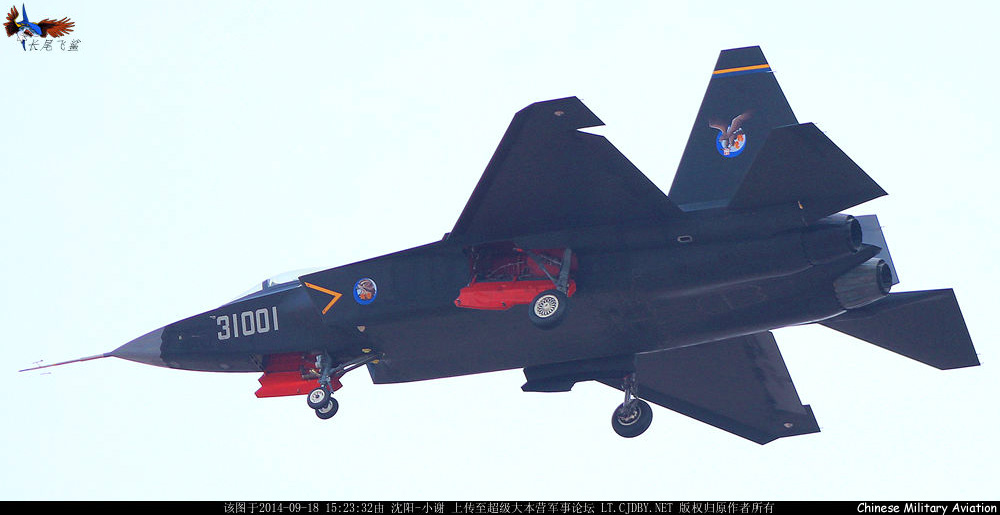
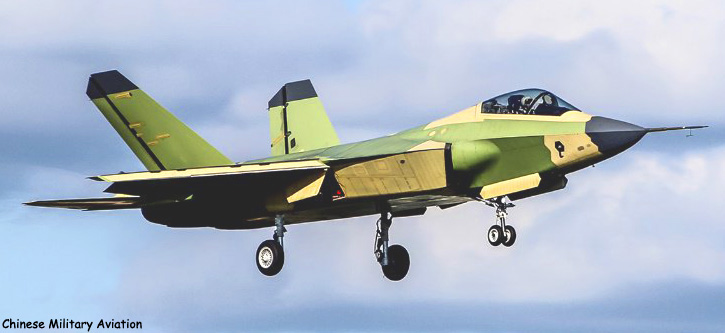
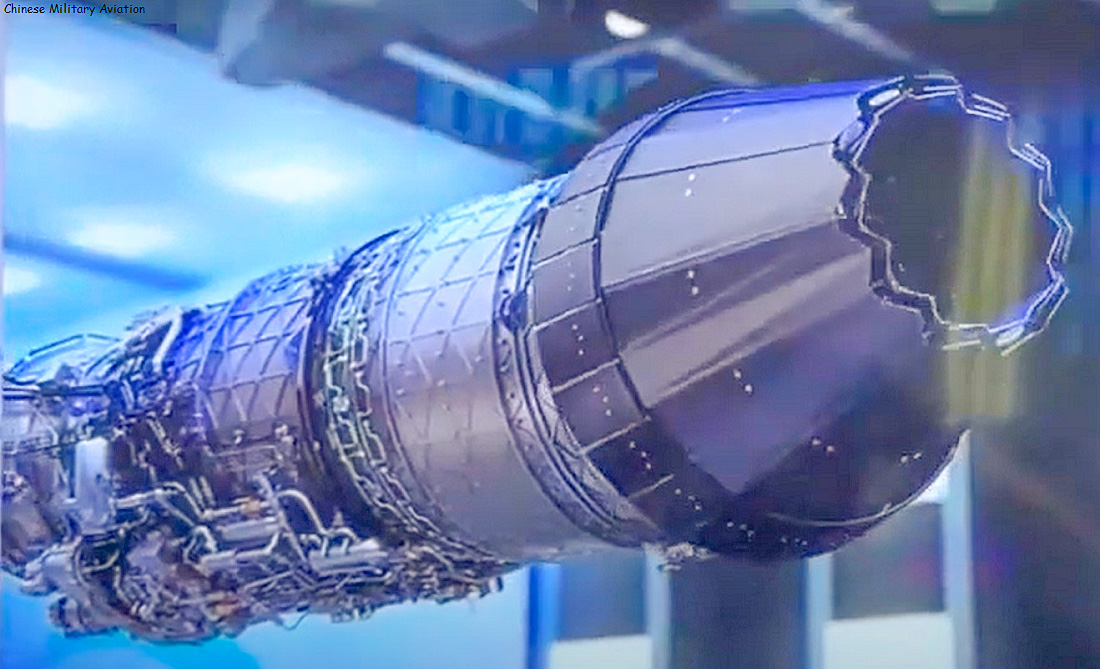
J-35/FC-31 Blue Shark/Gyrfalcon One of the J-35 prototypes (#3505?) was approaching the SAC airfield after a routine test flight. This aircraft has evolved from the earlier FC-31 (Project 310), an export stealth fighter which has a conventional design with twin engines and two large canted swept tail fins similar to American F-35. As the result the ventral stabilizing fins are eliminated to save weight and reduce RCS. In addition it features DSIs, two piece canopy and a pentagon shaped nose similar to F-35. Like J-20, a retractable IFR probe could be installed on the starboard side slightly forward of the canopy. As a 4th generation fighter FC-31 is expected to be equipped with advanced avionics such as an AESA radar and a glass cockpit featuring three large color LED MFDs and a wide-angle holographic HUD. The aircraft could eventually be fitted an F-35 style single piece extra-large panoramic cockpit display (PCD) as specified by the customer. The avionics suite is believed to have been tested onboard a Y-8 testbed with a modified nose. The prototype was initially powered by the Russian RD-33 turbofan (8.5t class) but later by the indigenous WS-13E (WS-21, 9t class). The engine nozzles on the 01 prototype initially appeared without any stealth measures applied. However they are partially shielded by the two horizontal stabilizers extending further back, similar to F-35, thus reduces the IR and radar signatures. FC-31 features a single internal weapons bay inside its belly housing up to 6 AAMs including PL-10E (to be followed by PL-16E), PL-15E and PL-21. The aircraft is also thought to have a secondary surface attack capability by carrying 50kg class SDBs internally such as LS-6/FT-7 satellite guided bombs and GB50 LGB, or the larger YJ-83K AshM and YJ-91 ARM externally under 6 hard points. An internal gun might be installed but its exact location is still unknown. Due to its relatively small size and lower engine thrust compared to J-20, FC-31 should have a smaller internal payload and a shorter combat radius. It is not expect to have the super-cruise capability initially either when powered by WS-21. However it does carry a relatively cheaper price tag and have a relatively "balanced" performance. Some specifications (speculated): length 17.3m, height 4.8m, wingspan 11.5m, normal TO weight 17.5t, MTOW 28t, combat radius 1,250km with internal fuel, max peed Mach 1.8, ceiling 16km, TO distance 450m, max g load +9/-3, max weapon load 8t (internal 2t, external 6t). It was first rumored in April 2011 that 601/SAC was developing a 4th generation medium multi-role stealth fighter as Project 310 since 2007 after its own heavy stealth fighter design lost the bid to 611/CAC's J-20 (see above). A scale-down model (dubbed F-60) of FC-31 was first unveiled by the 601 Institute in September 2011. A full-scale metal model was probably built in early 2011. One airframe was transported to the 623 Institute for static tests in June 2012. The 31001 prototype was under construction since late 2011. Its first flight took place on October 31, 2012, powered by two smoky RD-33 turbofans. It was rumored that the 01 prototype powered by two upgraded WS-21 turbofan engines flew for the first time on July 1, 2016. As a private venture of AVIC, FC-31 (initially dubbed AFC/Advanced Fighter Concept) has been promoted at the international market as a low-cost alternative to American F-35. Its first foreign customer is expected to be Pakistani AF (dubbed J-31), which has been the primary customer of Chinese made combat aircraft. FC-31 was partially unveiled at 2012 Zhuhai Airshow as an "advanced fighter concept". One image taken in December 2013 suggested that FC-31 was testing a new silver color "stealth" nozzle similar to those onboard J-20. The 03 prototype (02 airframe for the static test) was expected to feature "major" improvements in order to make it more attractive to domestic/foreign customers. Those improvements include a one-piece canopy, a new wide-angle holographic HUD similar to the one onboard J-20, two indigenous WS-21 turbofan engines with a higher thrust, a longer and fatter fuselage made of more composite materials, a bigger internal weapon bay, larger wing area, reshaped F-35 style tail fins and cropped wing and horizontal stabilizer tips similar to those of F-22. It also has the provisions for nose-mounted IRST, EODAS throughout the fuselage, as well as 6 underwing hardpoints to be installed later. An AVIC promotional video released at the 2016 Zhuhai Airshow indicated the 03 prototype was built and was preparing for the maiden flight. The high-speed taxiing test of the 03 prototype started on December 18, 2016. First flight took place on December 23, 2016, powered by two smokeless WS-13E engines. A recent image (September 2019) indicated that the o3 prototype has been wearing a light gray color scheme. It was rumored in October 2018 that a much redesigned variant has been selected by PLAN as its next generation carrier-based stealth fighter (as J-35, Project 1810?), featuring folding wings and a retractable arresting hook, powered by the new WS-19 Huangshan turbofan engines (10t class), possibly with TVC nozzles. Its MTOW is >30t. J-35 is expected to be stationed onboard the new Type 003 Fujian CATOBAR carrier featuring EMALS. It was rumored in September 2020 that a J-35 prototype (02?) was undergoing static test. A full-scale mockup was unveiled in June 2021. Compared to the FC-31 03 prototype, J-35 features foldable wings, a bigger wingspan, larger tail fins for better handlings at low speed/high AoA, a raised cockpit and deeper spine for a better pilot downward view as well as a bigger internal fuel capacity. A boarding ladder was speculated to be installed similar to that of F-35. A recent rumor (March 2021) suggested that a dedicated variant (J-31?) is being developed for PLAAF without arresting hook and folded wings. An airframe was rumored to have been transported to the 623 Institute for static tests in March 2022. First flight was speculated in late 2023. It was also speculated in mid-2023 that a J-35B tandem seat version similar to J-20B could be under development for training and EW purposes. The first flight of J-35 prototype (350001) in a green primer and powered by WS-21 turbofans with sawtooth nozzles occurred on October 29, 2021. The aircraft features a larger radome, a forward opening one-piece canopy with handholds attached for catapult launches, a new narrow frame holographic HUD, an HTY9 ejection seat similar to that onboard J-20, a retractable IFR probe on the starboard side of the cockpit, an IRST or EOTS underneath its nose plus a strengthened nose gear with twin wheels and a launch bar. It also has twin tail booms further stretched in order to move the horizontal stabilizers slightly backward. Consequently the aircraft handling at low speeds has been improved. A recent satellite image (November 2021) suggested that two J-35 mockups (?) were being evaluated at the PLAN Carrier Aviation Test & Training Base for training purposes. A recent image (May 2022) indicated that the 350001 prototype was wearing a gray color scheme and carrying low visibility PLAN markings. Recent images (July 2022) indicated that the 350003 prototype was built. A recent video (August 2023) indicated one J-35 prototype (#3505?) was flying over SAC with the nose pitot tube removed, suggesting an AESA radar may have been fitted inside. Another recent video (September 2023) suggested that another J-35 prototype (or the first J-31 prototype) just conducted its maiden flight over Shenyang. The latest rumor (December 2023) suggested that at least one WS-19 turbofan engine has been tested onboard a J-35. A full-scale mockup was first seen in November 2023 on the deck of Fujian. Another full-scale mockup was seen on the deck of Liaoning in February 2024, suggesting that J-35 is also capable of operating from a STOBAR carrier, which could significantly strengthen the power projection capability of Type 001/002 carriers Liaoning and Shandong. The latest images (March 2024) suggested that the J-35 3505 prototype has been conducting test flights with an arresting hook mounted between the two engines. The hook appears to be encased inside a stealth optimized “sheath” to reduce RCS. The development of J-35 is expected to be moved into the next phase as it prepares for launch tests from a land-based EMALS.